If you've been following us on Facebook or Twitter recently, you're probably aware that we've been in Egypt this past week.
Egypt? But isn't it unsafe now?
Last weekend, I arrived in Asheville, North Carolina to visit family. And boy, was I tired.
The last two months have been chock full: traveling from Central Europe to Crete to Istanbul to Iran, back to Istanbul, Germany and finally to a series of family visits up and down the east coast of the United States.
But I’ve been feeling a little spent. It’s not only the movement, but also my head, to the brim with fresh experiences and quite frankly deprived of the time and space to properly process them all. Amidst the fatigue, I began to wonder if perhaps I had reached some limit in what I could do, what I could take on.
An Iranian carpet, especially one from Tabriz, is worth more than gold.
— Our Iranian guide gives us an economics lesson in the old carpet section of the Tabriz bazaar.
The largest bazaar in the Middle East. The world's largest covered market. A UNESCO World Heritage site. That's the Tabriz bazaar. And deep inside, old men, purveyors of grand old Persian Azerbaijani carpets, drink tea, smoke qalyan, and stay open only four hours a day. Voices are low, relationships are being formed — and deals are being made.
Traveling to Iran as an American citizen may sound complicated and dangerous. It’s not. We’re here to dispel the myths and answer the questions piling up in our inbox about visas, safety, and other concerns based on our visit to Iran.
Our aim in the following Q&A is to answer actual reader queries and to help demystify the process of traveling to Iran, especially for Americans.
I'm going to show you something like you've never seen before.
— Our guide, just before entering the Shāh Chérāgh Mosque.
The Shāh-é-Chérāgh Mosque. It's a mausoleum, a funerary, one of the many places of worship and pilgrimage in Iran. But this one looks like a giant disco ball turned inside out.
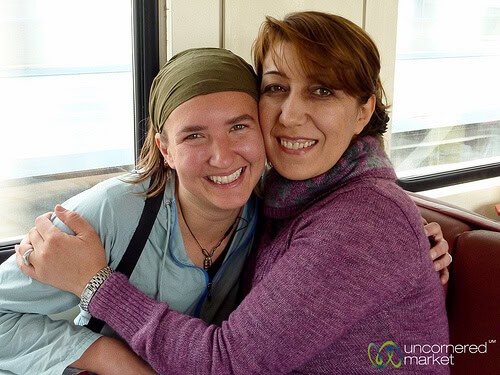
This is a story of a woman I met on a train in Iran and a letter she wrote to me — a letter I now read through tears.
My heart sank as I watched the news from Iran this morning, scenes of the British Embassy being charged by an angry mob in Tehran. It saddens me – angers me, really – that narrow groups like this who define the world’s perception of Iran and the Iranian people are in reality such a small percentage of the country's population.
My experience tells me they are the outliers, yet circumstances conspire to convince us on the outside to see them as the norm.
Although Persepolis is one of Iran’s top archeological and tourist sites, I was careful to keep my expectations in check before visiting. After all, what would remain of the 2,500 year-old capital of the Achaemenid Empire? Amidst crumbled columns, I found great detail that blew me away and a surprising connection to the present.
This is a very short story about music. In Iran.
I dont know that I've ever been so happy — or oddly surprised — to hear Stevie Wonder in my entire life.
I should explain.
There's nothing like early morning light falling through a stained-glass window…casting designs on a Persian carpet…amidst immaculately tiled pink columns.
This is the winter prayer hall inside the Pink Mosque in Shiraz, Iran.
We apologize for the silence on our blog over the last week. Our travels across Iran, while rich and deeply fulfilling, have teamed up with slow and censored internet, a blistering pace of full days that end late, and an attempt to process it all that feels like a slow drip.
Now that we've dispensed with the excuses, we offer a few snapshots of our journey to not-so-traveled Western Iran — Hamadan, Kermanshan, and Ahvaz — where our path through the country begins.